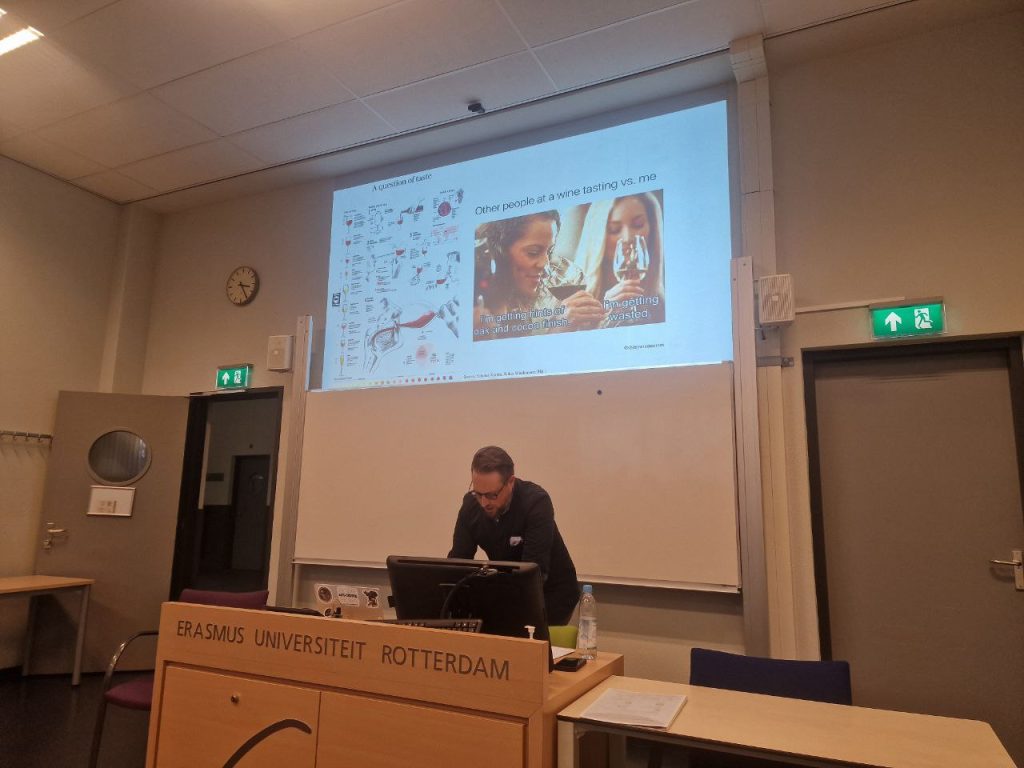
Lecture at Erasmus University Rotterdam: Sensing Machines: Michel Serres and the Five Senses of AI
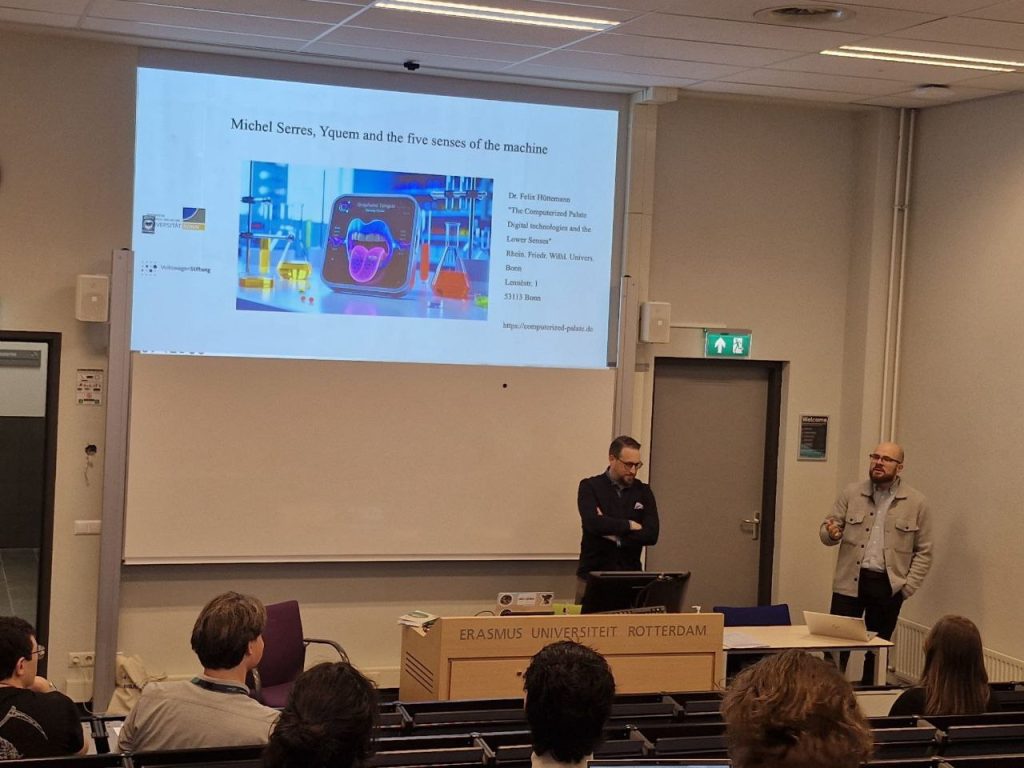
On November 5, 2025, Felix Hüttemann gave a lecture at the Institute of Philosophy and Technology of Erasmus University Rotterdam as part of the project. In his talk, he examined current sensor and AI couplings, which, as electronic noses and tongues, supposedly produce human-like perceptions. He based this on Michel Serres’ analysis of the five senses in relation to sensualism, Condillac, and Sauternes (Château d’Yquem).
Sensory media are aesthetic media par excellence, in that they make things perceptible to humans that would otherwise be imperceptible. His focus was on “sensing machines” in the broadest sense, which are more accurately described as “tasting machines.” This refers to “electronic sensors, machine ‘intelligence,’ human labor, and material infrastructures interwoven with our living, breathing, and moving bodies that sense, interpret, and act on the world” (Chris Salter: Sensing Machines, 2022, p. 4). His question was: What might computerization, or a media aesthetic, of the immediacy of digital media look like?
Serres’ reflections are quite representative of the media-philosophical examination of this media-aesthetic problem, for which reflection on human perception means a search for knowledge (Erkenntnis). He characterizes this reflection as a description of sensual, multisensory experience of mixtures and blends or – based on the French subtitle philosophie des corps mêlés – mingled bodies.
In doing so, he profiles a form of epistemology that, as the “science of sensory knowledge,” can be elaborated as a “lower epistemology” (Baumgarten 1988, §1) of mixtures and amalgams. With this approach, he reconceptualizes a previously marginalized part of aesthetics that focuses primarily on the theorization of human sensory perception and is not devoted to the primary sense of sight, but rather inquires into the tangible and fluid, taste and smell, as possibilities for another form of knowledge. With regard to the ambiguity of the Latin sapere, which can mean both to know and to taste, Serres assumes that only those who truly taste with insight or knowledge are homo sapiens. In this sense, sapere means not only to use one’s own intellect, but also one’s own taste.
What Michel Serres predicted in 1985 in his book The Five Senses, that computers would soon be able to distinguish not only Sauternes, a noble sweet white wine from Bordeaux, from Coca-Cola, has come true, thanks to a combination of sensor technology and large language models. In fact, sensor, and AI research are working to digitally generate, recognize, and store descriptions and evaluations of multisensory taste and smell profiles, ranging from culinary arts and perfumery to human odors in medicine and pharmacy.
In The Five Senses, Serres conceives of aesthetics as aisthetics while simultaneously criticizing logocentrism. Serres’ aisthetics of media means nothing other than an examination of the conditions of the possibility of perceiving the world through media, but also a perception of media. At the same time, it is a contrast to the now canonical thesis of media becoming an-aisthetic in the execution of mediation.
Felix Hüttemann’s talk was followed by a response from Aldo Houterman and an open discussion.